Yesterday, I went back into the studio for the first time in 2 years! This lapse is due to my commitment to get my masters degree and although I've been directing and writing, contraints on my time (kids, life, etc) have not made it feasible for me to arrange studio time. For a while this situtation has been fruitful in that I've been able to focus on my writing without the pressure of running a theater company and producing theater. Don't get me wrong: disengaging from my company, (which has been my avocation since my early twenties) was disorienting; the first summer I wasn't in rehearsal I felt like I had lost a limb.
To a large degree that emptiness was necessary and I had to struggle not to fill it up, to just allow it to take me. It was hard to let the company go - for me there was a sense of loss and and a huge sense of failure. But I had become frustrated and bitter about producing theater in San Francisco. In the end, the company just couldn't create any momentum either within the SF community or within the company itself. I suspect that these two things are interdependent. Navigating through the loss made me aware of the influence the company mission exerted on my work and my growing discomfort with the limitations I feel that mission imposed. More on this later, because it's a topic in itself.
A friend asked me recently, if I ever feel like I'm in the wrong place, echoing a question that one of my teachers and mentors had asked almost ten years ago. The first time I was asked the question, the answer was no. Now, I'm not so sure. I had a common denominator moment recently, when I worked with a local company in the development of their annual summer touring show that left me in a tailspin wondering why I have such difficulty connecting to artists in SF (Get Down! notwithstanding).
It would be one thing if I were met with indifference where ever I worked and with whomever I came into contact. I would be willing to accept defeat if I couldnt get anyone anywhere excited about my work , but that is not the case. It just seems to be rooted in SF. The truth is, I see so little theater in San Francisco that stops me in my tracks and much that thinks it is so much more than it is - either out of naiveté (which is forgivable) or arrogance (which grows tedious overtime). The dance community, on the other hand, is remarkable and for the most part, is the only community to have gotten excited about the work I am doing. So maybe that's my answer right there.
At any rate, I fluctuate between absolute certainty that I'm in the wrong place and then I have a day like yesterday when going back into the studio and working left me feeling inspired and engerized. It's clear to me that I want to continue producing theater, but perhaps not specifically in San Francisco and perhaps with a new vision of production.
All of this is my way of saying that my work in the studio has given me insight about what I want to focus on in this blog and made me realize that what I want to do may require more than one, so expect to see some interesting changes in the next few months.
Ongi Etori! (as I understand it, that is the French Basque version of "live free or die!"
Monday, May 01, 2006


Thursday, April 27, 2006
Monday, April 24, 2006
Post 9/11 Syndrome
George Lakoff discusses, among other issues, how the language and visual imagery of 9/11 frames our experience (acceptance) of the War on Terror.
BLVR: Can you explain to me in layman’s neuroscience terms how September 11 changed the way we think?Full article at Believer Magazine.
GL: It reshaped our brains. That’s why they had to keep showing the towers falling over and over and over again. The imagery meant that the towers were people. The planes going in are like bullets going through your brain, the people falling are you falling. Here’s a picture of you dying. The other thing was it was framed in terms of war, instead of crime. Then it was not just war, but metaphorical war, where the enemy is this abstract thing: terror. Terror, which is in you. That’s what’s sort of weird. The enemy is inside America. It’s terror, not terrorists, the outside guys. Of course, by saying ña war on terrorî you can never feel safe. The locus of the war is in you.
BLVR: Are the conservatives who formulated all of these terms aware of these other meanings?
GL: Yeah. I suspect Karen Hughes is smart enough to understand that.
BLVR: Really?
GL: Sure. Think about the image of those towers falling. Think about your empathic response. What you see there you feel in your body. You feel that the terror is in you. You feel that the destruction is in you. Just by looking at it over and over and over, it’s come into you, it’s changed your brain. And so you become the war. It’s not over there in Iraq. Now, you justify the war by saying, “It’s better that it’s fought there than here,” which is the relief. But of course, metaphorically, it’s here. There are people all over the Midwest worrying about the war, especially women, who are empathic, feeling it themselves, worrying that the war is going to come to Peoria, Illinois.
Tangled Up in Bob
Writer Nathalie Goldberg travels to Bob Dylan's hometown, Hibbing, MN, and discovers how place informs creativity and artistic vision. A new film by Mary Feidt.
Sunday, April 23, 2006
Crisis of Leadership
In today's NY Times, younger officers discuss war in Iraq, whether Rumsfeld should go, and what responsibility Bush shares in this mess. Looks like there's enough blame to go around.
"The Army, however, went gently into that good night of Iraq without saying a word," he added, summarizing conversations with other officers. "For that reason, most of us know that we have to share the burden of responsibility for this tragedy. And at the end of the day, it wasn't Rumsfeld who sent us to war, it was the president. Officers know better than anyone else that the buck stops at the top. I think we are too deep into this for Rumsfeld's resignation to mean much.
"But this is all academic. Most officers would acknowledge that we cannot leave Iraq, regardless of their thoughts on the invasion. We destroyed the internal security of that state, so now we have to restore it. Otherwise, we will just return later, when it is even more terrible."
The debates are fueled by the desire to mete out blame for the situation in Iraq, a drawn-out war that has taken many military lives and has no clear end in sight. A midgrade officer who has served two tours in Iraq said a number of his cohorts were angered last month when Secretary of State Condoleezza Rice said that "tactical errors, a thousand of them, I am sure," had been made in Iraq.
"We have not lost a single tactical engagement on the ground in Iraq," the officer said, noting that the definition of tactical missions is specific movements against an enemy target. "The mistakes have all been at the strategic and political levels."
More here.
Saturday, April 22, 2006
Piefurcation Recommends
 Our Town
Directed by Warren David Keith
University Theatre
San Jose Sate University
April 22, 27, 28, 29 at 7pm
April 26 matinee at 11am
Tickets: $15 General Admission
$10 for students, SJSU staff and faculty, and seniors
Available at the Event Center, online and at the door.
The University Theatre is located next door to the New MLK Library at 5th & San Fernando.
Park free after 6pm across the street at the new 4th St. City Garage.
Deborah Slater Dance Theater's
Hotel of Memories
More Furniture Dances
"Pay what you can" Previews: May 13 & 14, 2006 | 8:00pm
Studio 210
3435 Cesar Chavez (at Valencia)
San Francisco, CA
For reservations and information call (415) 267-7687
May 18 - June 3, 2006 | Thursday, Friday, Saturday 8:00pm
CounterPULSE
1310 Mission Street
San Francisco, CA
For reservations and information call (415) 435-7552
Tickets available online at http://artofthematter.org through Paypal
Hotel of Memories
More Furniture Dances

"Pay what you can" Previews: May 13 & 14, 2006 | 8:00pm
Studio 210
3435 Cesar Chavez (at Valencia)
San Francisco, CA
For reservations and information call (415) 267-7687
May 18 - June 3, 2006 | Thursday, Friday, Saturday 8:00pm
CounterPULSE
1310 Mission Street
San Francisco, CA
For reservations and information call (415) 435-7552
Tickets available online at http://artofthematter.org through Paypal

 The Faith Project
May 11 – 20 at 8pm/May 21 at 2pm
The Studio Theatre
Robert & Margrit Mondavi Center for the Performing Arts
Davis, CA
$8 for students and $12 for the general admission
Purchase tickets at http://www.mondaviarts.org or call 530/754-2787toll free at 866/754-ARTS.
A multi-disciplinary theatre piece that follows one fictional congregation as they struggle to find answers from an elusive God and a conflicted country. The production draws on the multi-ethnic ensemble’s personal stories and research into various faith practices, and incorporates audio-taped interviews with clergy, scholars, and people on the street.
Written & directed by Susannah Martin
Choreograhpy by Kristin Heavey
Music composed & directed by Dave Malloy
Written & performed by Jennifer Arnoth, Samantha Blanchard, Christopher Maikish, Karen Marek, Ashanti Newton, Michael Ortiz, Karuna Tanahashi, Natasha Tavakoli, Carolyn Thomas, & Rosa Threlfall
Thursday, April 20, 2006
No Pulitzer For You!
Denied. Denied. Denied. No Pulitzer Prize for a playwright this year.
From LA Times
From LA Times
Adam Rapp, who was among the three finalists for his play "Red Light in Winter," said Tuesday that the lack of a drama award was like "a year without a Santa Claus" for playwrights.From Bloomberg.com
Rapp would have been happy if either of the other finalists, Christopher Durang for his play "Miss Witherspoon" or Rolin Jones for "The Intelligent Design of Jenny Chow," had won. (Jones' play premiered at South Coast Repertory in Costa Mesa.) But Rapp added: "Not to name a winner when there are three plays worthy of being finalists is a little obnoxious. I feel like our vocation is a dying species in America. We need everyone supporting us as much as possible. Telling stories in the theater is an important thing. Playwrights are moving to the West Coast to do TV and film just to stay solvent."
The omission of a drama award, for the 15th time since the inception of the prizes in 1917, denies prestige, $10,000 and a key marketing tool to an American playwright. It also sends an implicit message that 2005 was an off year for new U.S. plays.
``We're not in the business of sending signals,'' said Sig Gissler, administrator of the awards and an associate professor at Columbia University's Graduate School of Journalism. ``We let the decisions speak for themselves. Sometimes you don't get a winner in a category.''
What A Splendid Pie
The history of Pizza in America.
"Everybody likes pizza. Even those who claim to be immune to its charms must deign to have the occasional slice; a staggering 93 percent of Americans eat pizza at least once a month. According to one study, each man, woman, and child consumes an average of 23 pounds of pie every year."Once a month? Are you kidding? More like once a week. Frozen pizza (no matter how good) does not count toward the quota. Yes. Obviously I'm consuming more than my fair share.
Safe Haven
Eleanor Bader writes about the Haven Coalition, an organization that provides shelter to women going to NYC for a late term abortion.
Celestial Seasonings
SIX INSPIRATIONAL
SAYINGS I'VE YET TO
FIND ON THE SIDE OF
A BOX OF TEA.
A BOX OF TEA.
- - - -
1.
When life is seen to flow slowly, like a deep river content in its path, the journey is a certain pleasure. But, God damn it, life's not always a big party, now, is it?
Get the rest here.
Wednesday, April 19, 2006
Beware "The Decider"

Lemon Creme Brulee Tart

I made this tart for the Staff Appreciation Luncheon at my son's school. This is the stylized version that appeared in the April 2004 issue of BON APPÉTIT . Needless to say, mine doesn't look exactly like this, the crust shrunk in the tart pan and I haven't yet carmelized the sugar on top. Delicious none the less. It's pretty simple to make. I didn't have the will for it at midnight, although I managed to get the crust prepared. It takes two hours to chill, you know, the butter and fats thing. Get the recipe here.
Tuesday, April 18, 2006
SOS: Different Century
 "Democracy having lost all significance in the minds of most statesmen and politicians, that is why such abundant use of military secrecy is being made in our time. It may be said in fact that the right to withhold information from the people on the basis of security reasons is the greatest loot the winning democracies have taken over from the totalitarian countries. And, most unfortunately, the people in our age having become so dejected, so unwilling to assert any right other than that of existing materially, the statesmen get away with the most incredible nonsense." Niccolo Tucci, The Fallacy of Constructive Criticism, Partisan Review, 1949.
Sunday, April 16, 2006
What would Jesus Do?
 Dear George:
If God is on your side, whispering in your ear, are you sure he said "Nuke Tehran?" Maybe what he was saying was make them a nice cucumber salad? As in: "Cuke Tehran." Better make sure. They're kinda different.
Sincerely Concerned for the Safety of All Sentient Beings,
Saturday, April 15, 2006
Put This Bunny Back in the Box. Come On, I Dare You.
 Sure, I'll be eternally grateful for the Marshmallow Peeps, but I'll never get past what you did to that poor chicken! The secret life and times of the Easter Bunny.
Thursday, April 13, 2006
A Blank Check
Wonder how much the Iraq war is costing you right now! See a running total here. Caution: This baby moves fast! You can also see how much of the bill your particular community is footing.
Birth was the death of him.
 To be an artist is to fail, as no other dare fail, that failure is his world and to shrink from it desertion, art and craft, good housekeeping, living. I know that all that is required now, in order to bring even this horrible matter to an acceptable conclusion, is to make of this submission, this admission, this fidelity to failure, a new occasion, a new term of relation, and of the act which, unable to act, obliged to act, he makes, an expressive act, even if only of itself, of its impossibility, of its obligation.
Happy Birthday, Sam.
Wednesday, April 12, 2006

Monday, April 10, 2006
O Ye Critics, Will Nothing Melt Ye?
AN ART-HISTORY
PROFESSOR EXPLAINS
TO HIS 4-YEAR-OLD
DAUGHTER WHY THE FAIR
MARKET VALUE OF HER
PICTURE IS ACTUALLY
FAR LESS THAN THAT OF
A THOUSAND WORDS.
- - - -
You chose to work with a blue Crayola crayon, and I respect that. You've been using a lot of blues lately, and I think you're on to something. It's a good idea to work out some themes and learn some techniques by limiting your palette. Nevertheless, your picture feels incomplete to me. Formwise, it's a staticky blue cloud hovering in space. There's nothing dynamic about it. You didn't even push down on the crayon very hard, so there isn't really any depth of color. There isn't a single interesting line, and the negative space, though overwhelming, seems to have been completely ignored. This image evokes nothing in me. I can't even call it ugly. It's just so-so. Honestly, I'm amazed I've even been able to say this much about it.Get the rest here at McSweeny's.
Sunday, April 09, 2006
Rain and the Rhinoceros by Thomas Merton
Let me say this before rain becomes a utility that they can plan and distribute for money. By "they" I mean the people who cannot understand that rain is a festival, who do not appreciate its gratuity, who think that what has no price has no value, that what cannot be sold is not real, so that the only way to make something actual is to place it on the market. The time will come when they will sell you even your rain. At the moment it is still free, and I am in it. I celebrate its gratuity and its meaninglessness.
The rain I am in is not like the rain of cities. It fills the woods with an immense and confused sound. It covers the flat roof of the cabin and its porch with inconsistent and controlled rhythms. And I listen, because it reminds me again and again that the whole world runs by rhythms I have not yet learned to recognize, rhythms that are not those of the engineer.
I came up here from the monastery last night, sloshing through the cornfield, said Vespers, and put some oatmeal on the Coleman stove for supper. It boiled over while I was listening to the rain and toasting a piece of bread at the log fire. The night became very dark. The rain surrounded the whole cabin with its enormous virginal myth, a whole world of meaning, of secrecy, of silence, of rumor. Think of it: all that speech pouring down, selling nothing, judging nobody, drenching the thick mulch of dead leaves, soaking the trees, filling the gullies and crannies of the wood with water, washing out the places where men have stripped the hillside! What a thing it is to sit absolutely alone, in the forest, at night, cherished by this wonderful, unintelligible, perfectly innocent speech, the most comforting speech in the world, the talk that rain makes by itself all over the ridges, and the talk of the watercourses everywhere in the hollows!
Nobody started it, nobody is going to stop it. It will talk as long as it wants, this rain. As long as it talks I am going to listen.
But I am also going to sleep, because here in this wilderness I have learned how to sleep again. Here I am not alien. The trees I know, the night I know, the rain I know. I close my eyes and instantly sink into the whole rainy world of which I am a part, and the world goes on with me in it, for I am not alien to it. I am alien to the noises of cities, of people, to the greed of machinery that does not sleep, the hum of power that eats up the night. Where rain, sunlight and darkness are contemned, I cannot sleep. I do not trust anything that has been fabricated to replace the climate of woods or prairies. I can have no confidence in places where the air is first fouled and then cleansed, where the water is first made deadly and then made safe with other poisons. There is nothing in the world of buildings that is not fabricated, and if a tree gets in among the apartment houses by mistake it is taught to grow chemically. It is given a precise reason for existing. They put a sign on it saying it is for health, beauty, perspective; that it is for peace, for prosperity; that it was planted by the mayor's daughter. All of this is mystification. The city itself lives on its own myth. Instead of waking up and silently existing, the city people prefer a stubborn and fabricated dream; they do not care to be a part of the night, or to be merely of the world. They have constructed a world outside the world, against the world, a world of mechanical fictions which contemn nature and seek only to use it up, thus preventing it from renewing itself and man.
Of course the festival of rain cannot be stopped, even in the city. The woman from the delicatessen scampers along the sidewalk with a newspaper over her head. The streets, suddenly washed, became transparent and alive, and the noise of traffic becomes a plashing of fountains. One would think that urban man in a rainstorm would have to take account of nature in its wetness and freshness, its baptism and its renewal. But the rain brings no renewal to the city, on to tomorrow's weather, and the glint of windows in tall buildings will then have nothing to do with the new sky. All "reality" will remain somewhere inside those walls, counting itself and selling itself with fantastically complex determination. Meanwhile the obsessed citizens plunge through the rain bearing the load of their obsessions, slightly more vulnerable than before, but still only barely aware of external realities. They do not see that the streets shine beautifully, that they themselves are walking on stars and water, that they are running in skies to catch a bus or a taxi, to shelter somewhere in the press of irritated humans, the faces of advertisements and the dim, cretinous sound of unidentified music. But they must know that there is wetness abroad. Perhaps they even feel it. I cannot say. Their complaints are mechanical and without spirit.
Naturally no one can believe the things they say about the rain. It all implies one basic lie: only the city is real. That weather, not being planned, not being fabricated, is an impertinence, a wen on the visage of progress. (Just a simple little operation, and the whole mess may become relatively tolerable. Let business make the rain. This will give it meaning.)
Thoreau sat in his cabin and criticized the railways. I sit in mine and wonder about a world that has, well, progressed. I must read Walden again, and see if Thoreau already guessed that he was part of what he thought he could escape. But it is not a matter of "escaping." It is not even a matter of protesting very audibly. Technology is here, even in the cabin. True, the utility line is not here yet, and so G.E. is not here yet either. When the utilities and G.E. enter my cabin arm in arm it will be nobody's fault but my own. I admit it. I am not kidding anybody, even myself. I will suffer their bluff and patronizing complacencies in silence. I will let them think they know what I am doing here.
They are convinced that I am having fun.
This has already been brought home to me with a wallop by my Coleman lantern. Beautiful lamp: It burns white gas and sings viciously but gives out a splendid green light in which I read Philoxenos, a sixth-century Syrian hermit. Philoxenos fits in with the rain and the festival of night. Of this, more later. Meanwhile: what does my Coleman lantern tell me? (Coleman's philosophy is printed on the cardboard box which I have (guiltily) not shellacked as I was supposed to, and which I have tossed in the woodshed behind the hickory chunks.) Coleman says that the light is good, and has a reason: it "Stretches days to give more hours of fun."
Can't I just be in the woods without any special reason? Just being in the woods, at night, in the cabin, is something too excellent to be justified or explained! It just is. There are always a few people who are in the woods at night, in the rain (because if there were not the world would have ended), and I am one of them. We are not having fun, we are not "having" anything, we are not "stretching our days," and if we had fun it would not be measured by hours. Though as a matter of fact that is what fun seems to be: a state of diffuse excitation that can be measured by the clock and "stretched" by an appliance.
There is no clock that can measure the speech of this rain that falls all night on the drowned and lonely forest.
Of course at three-thirty A.M. the SAC plane goes over, red light winking low under the clouds, skimming the wooded summits on the south side of the valley, loaded with strong medicine. Very strong. Strong enough to burn up all these woods and stretch our hours of fun into eternities.
And that brings me to Philoxenos, a Syrian who had fun in the sixth century, without benefit of appliances, still less of nuclear deterrents.
Philoxenos in his ninth memra (on poverty) to dwellers in solitude, says that there is no explanation and no justification for the solitary life, since it is without a law. To be contemplative is therefore to be an outlaw. As was Christ. As was Paul.
One who is not "alone," says Philoxenos, has not discovered his identity. He seems to be alone, perhaps, for he experiences himself as "individual." But because he is willingly enclosed and limited by the laws and illusions of collective existence, he has no more identity than an unborn child in the womb. He is not yet conscious. He is alien to his own truth. He has senses, but he cannot use them. He has life, but not identity. To have an identity, he has to be awake, and aware. But to be awake, he has to accept vulnerability and death. Not for their own sake: not out of stoicism or despair-only for the sake of the invulnerable inner reality which we cannot recognize (which we can only be ) but to which we awaken only when we see the unreality of our vulnerable shell. The discovery of this inner self is an act and affirmation of solitude.
Now if we take our vulnerable shell to be our true identity, if we think our mask is our true face, we will protect it with fabrications even at the cost of violating our own truth. This seems to be the collective endeavor of society: the more busily men dedicate themselves to it, the more certainly it becomes a collective illusion, until in the end we have the enormous, obsessive, uncontrollable dynamic of fabrications designed to protect mere fictitious identities-- "selves," that is to say, regarded as objects. Selves that can stand back and see themselves having fun (an illusion which reassures them that they are real).
Such is the ignorance which is taken to be the axiomatic foundation of all knowledge in the human collectivity: in order to experience yourself as real, you have to suppress the awareness of your contingency, your unreality, your state of radical need. This you do by creating an awareness of yourself as one who has no needs that he cannot immediately fulfill. Basically, this is an illusion of omnipotence: an illusion which the collectivity arrogates to itself, and consents to share with its individual members in proportion as they submit to its more central and more rigid fabrications.
You have needs; but if you behave and conform you can participate in the collective power. You can then satisfy all your needs. Meanwhile, in order to increase its power over you, the collectivity increases your needs. It also tightens its demand for conformity. Thus you can become all the more committed to the collective illusion in proportion to becoming more hopelessly mortgaged to collective power.
How does this work? The collectivity informs and shapes your will to happiness ("have fun") by presenting you with irresistible images of yourself as you would like to be: having fun that is so perfectly credible that it allows no interference of conscious doubt. In theory such a good time can be so convincing that you are no longer aware of even a remote possibility that it might change into something less satisfying. In practice, expensive fun always admits of a doubt, which blossoms out into another full-blown need, which then calls for a still more credible and more costly refinement of satisfaction, which again fails you. The end of the cycle is despair.
Because we live in a womb of collective illusion, our freedom remains abortive. Our capacities for joy, peace, and truth are never liberated. They can never be used. We are prisoners of a process, a dialectic of false promises and real deceptions ending in futility.
"The unborn child," says Philoxenos, "is already perfect and fully constituted in his nature, with all his senses, and limbs, but he cannot make use of them in their natural functions, because, in the womb, he cannot strengthen or develop them for such use."
Now, since all things have their season, there is a time to be unborn. We must begin, indeed, in the social womb. There is a time for warmth in the collective myth. But there is also a time to be born. He who is spiritually "born" as a mature identity is liberated from the enclosing womb of myth and prejudice. He learns to think for himself, guided no longer by the dictates of need and by the systems and processes designed to create artificial needs and then "satisfy" them.
This emancipation can take two forms: first that of the active life, which liberates itself from enslavement to necessity by considering and serving the needs of others, without thought of personal interest or return. And second, the contemplative life, which must not be construed as an escape from time and matter, from social responsibility and from the life of sense, but rather, as an advance into solitude and the desert, a confrontation with poverty and the void, a renunciation of the empirical self, in the presence of death, and nothingness, in order to overcome the ignorance and error that spring from the fear of "being nothing." The man who dares to be alone can come to see that the "empitness" and "uselessness" which the collective mind fears and condemns are necessary conditions for the encounter with truth.
It is in the desert of loneliness and emptiness that the fear of death and the need for self-affirmation are seen to be illusory. When this is faced, then anguish is not necessarily overcome, but it can be accepted and understood. Thus, in the heart of anguish are found the gifts of peace and understanding: not simply in personal illumination and liberation, but by commitment and empathy, for the contemplative must assume the universal anguish and the inescapable condition of mortal man. The solitary, far from enclosing himself in himself, becomes every man. He dwells in the solitude, the poverty, the indigence of every man.
It is in this sense that the hermit, according to Philoxenos, imitates Christ. For in Christ, God takes to Himself the solitude and dereliction of man: every man. From the moment Christ went out into the desert to be tempted, the loneliness, the temptation and the hunger of every man became the loneliness, temptation and hunger of Christ. But in return, the gift of truth with which Christ dispelled the three kinds of illusion offered him in his temptation (security, reputation and power) can become also our own truth, if we can only accept it. It is offered to us also in temptation. "You too go out into the desert," said Philoxenos, "having with you nothing of the world, and the Holy Spirit will go with you. See the freedom with which Jesus has gone forth, and go forth like Him-see where he has left the rule of men; leave the rule of the world where he has left the law, and go out with him to fight the power of error."
And where is the power of error? We find it was after all not in the city, but in ourselves .
Today the insights of a Philoxenos are to be sought less in the tracts of theologians than in the meditations of the existentialists and in the Theater of the Absurd. The problem of Berenger, in Ionesco's Rhinoceros, is the problem of the human person stranded and alone in what threatens to become a society of monsters. In the sixth century Berenger might perhaps have walked off into the desert of Scete, without too much concern over the fact that all his fellow citizens, all his friends, and even his girl Daisy, had turned into rhinoceroses.
The problem today is that there are no deserts, only dude ranches.
The desert islands are places where the wicked little characters in the Lord of the Flies come face to face with the Lord of the Flies, form a small, tight, ferocious collectivity of painted face, and arm themselves with spears to hunt down the last member of their group who still remembers with nostalgia the possibilities of rational discourse.
Where Berenger finds himself suddenly the last human in a rhinoceros herd he looks into the mirror and says, humbly enough, "After all, man is not as bad as all that, is he?" But his world now shakes mightily with the stampede of his metamorphosed fellow citizens, and he soon becomes aware that the very stampede itself is the most telling and tragic of all arguments. For when he considers going out into the street "to try to convince them," he realizes that he "would have to learn their language." He looks in the mirror and sees that he no longer resembles anyone . He searches madly for a photograph of people as they were before the big change. But now humanity itself has become incredible, as well as hideous. To be the last man in the rhinoceros herd is, in fact, to be a monster.
Such is the problem which Ionesco sets us in his tragic irony: solitude and dissent become more and more impossible, more and more absurd. That Berenger finally accepts his absurdity and rushes out to challenge the whole herd only points up the futility of a commitment to rebellion. At the same time in The New Tenant (Le Nouveau Locataire ) Ionesco portrays the absurdity of a logically consistent individualism which, in fact, is a self-isolation by the pseudo-logic of proliferating needs and possessions.
Ionesco protested that the New York production of Rhinoceros as a farce was a complete misunderstanding of his intention. It is a play not merely against conformism but about totalitarianism. The rhinoceros is not an amiable beast, and with him around the fun ceases and things begin to get serious. Everything has to make sense and be totally useful to the totally obsessive operation. At the same time Ionesco was criticized for not giving the audience "something positive" to take away with them, instead of just "refusing the human adventure." (Presumably "rhinoceritis" is the latest in human adventure!) He replied: "They [the spectators] leave in a void-and that was my intention. It is the business of a free man to pull himself out of this void by his own power and not by the power of other people!" In this Ionesco comes very close to Zen and to Christian eremitism.
"In all the cities of the world, it is the same," says Ionesco. "The universal and modern man is the man in a rush (i.e. a rhinoceros), a man who has no time, who is a prisoner of necessity, who cannot understand that a thing might perhaps be without usefulness ; nor does he understand that, at bottom, it is the useful that may be a useless and back-breaking burden. If one does not understand the usefulness of the useless and the uselessness of the useful, one cannot understand art. And a country where art is not understood is a country of slaves and robots." (Notes et Contre Notes, p129) Rhinoceritis, he adds, is the sickness that lies in wait "for those who have lost the sense and the taste for solitude."
The love of solitude is sometimes condemned as "hatred of our fellow men." But is this true? If we push our analysis of collective thinking a little further we will find that the dialectic of power and need, of submission and satisfaction, ends by being a dialectic of hate. Collectivity needs not only to absorb everyone it can, but also implicitly to hate and destroy whoever cannot be absorbed. Paradoxically, one of the needs of collectivity is to reject certain classes, or races, or groups, in order to strengthen its own self-awareness by hating them instead of absorbing them.
Thus the solitary cannot survive unless he is capable of loving everyone, without concern for the fact that he is likely to be regarded by all of them as a traitor. Only the man who has fully attained his own spiritual identity can live without the need to kill, and without the need of a doctrine that permits him to do so with a good conscience. There will always be a place, says Ionesco, " for those isolated consciences who have stood up for the universal conscience " as against the mass mind. But their place is solitude. They have no other. Hence it is the solitary person (whether in the city or in the desert) who does mankind the inestimable favor of reminding it of its true capacity for maturity, liberty and peace.
It sounds very much like Philoxenos to me.
And it sounds like what the rain says. We still carry this burden of illusion because we do not dare to lay it down. We suffer all the need that society demands we suffer, because if we do not have these needs we lose our "usefulness" in society-the usefulness of suckers. We fear to be alone, and to be ourselves, and so to remind others of the truth that is in them.
"I will not make you such rich men as have need of many things," said Philoxenos (putting the words on the lips of Christ), "but I will make you true rich men who have need of nothing. Since it is not he who has many possessions that is rich, but he who has no needs." Obviously, we shall always have some needs. But only he who has the simplest and most natural needs can be considered to be without needs, since the only needs he has are real ones, and the real ones are not hard to fulfill if one is a free man!
The rain has stopped. The afternoon sun slants through the pine trees: and how those useless needles smell in the clear air!
A dandelion, long out of season, has pushed itself into bloom between the smashed leaves of last summer's day lilies. The valley resounds with the totally uninformative talk of creeks and wild water.
Then the quails begin their sweet whistling in the wet bushes. Their noise is absolutely useless, and so is the delight I take in it. There is nothing I would rather hear, not because it is a better noise than other noises, but because it is the voice of the present moment, the present festival.
Yet even here the earth shakes. Over at Fort Knox the Rhinoceros is having fun.
The Joys of Whoredom
Have you ever been plagued by repetitive thoughts? For the past week or so, I've had one thought sail through my head at least 20 or more times a day. It induces the most profound school-girl type giddyness.
"Sean, you no-talent whore!" Alec BaldwinI don't presume everyone shares my obsessions, but just in case, you can hear it all again here. (from Crooks and Liars)
Saturday, April 08, 2006
The Big Dance
A friend of mine gave me a subscription to the Oxford American, a magazine that features southern writers. My first issue arrived the other day and this article grabbed me by the scruff of the neck. I don't participate in the Duke - UNC rivalry (unlike others in my home I could mention); I get my hate on with U of L - UK. I think Willy gets it right about basketball and a few other things southern.
Read: The Art of Hatred
Fanaticism and the Duke-UNC basketball rivalry.
by Willy Blythe
Read: The Art of Hatred
Fanaticism and the Duke-UNC basketball rivalry.
by Willy Blythe
7 Life Lessons Learned from Pixar Movies
- Don't be afraid to use you special powers.
- Overparenting can backfire.
- It's better to have people like you than fear you.
- With pluck and persistence, you just may get the princess.
- Follow your heart, even when it feels scary.
- Be nice to the new kid on the block.
- A bad haircut is not the end of the world.
Words of Advice from Charles Isherwood
NYT theater critic, Charles Isherwood, sums up the 2006 Humana Fesitval thusly:
"There's not much point in aiming high if you can't hit your target. And is it really necessary for playwrights to dream up new worlds? As Ms. Rebeck's intimate and affecting play reminds us, the one we live in still provides durable material for theater that moves us, makes us laugh and allows us to see even a small frame of experience in a new light."Got that? Aim low unless you're absolutely certain you won't fail.
I get his point about there still being material in the world to be mined, but can't something else be made of quotidian life other than naturalism? And can't those other forms be just as intimate and affecting?
O'Neill didn't hit his target every time, but if he had let that stop him, we might never have had The Hairy Ape, A Touch of the Poet, or Long Day's Journey Into Night.
Ponder failure in its many forms at The Institute of Failure. Interesting side note: My first attempt at embedding this link failed; anyone clicking on the link landed at Microsoft. Failure or fate?
FYI: Better Living Through Derangement
 Proverbs for Paranoids by Thomas Pynchon
1. You may never get to touch the Master, but you can tickle his creatures.
2. The innocence of the creatures is in inverse proportion to the immorality of the Master.
3. If they can get you asking the wrong questions, they don't have to worry about the answers.
4. You hide, they seek.
5. Paranoids are not paranoids because they're paranoid, but because they keep putting themselves, fucking idiots, deliberately into paranoid situations.
Or as someone once told me, paranoia is the art of completely synthesizing your environment...
Thursday, April 06, 2006
Pie Recipe! Chocolate Pecan
It's been brought to my attention that the pie recipes sometimes escape notice. Well...I've only put up two and they're both Chocolate Pecan. I have my reasons...
So. I'm breaking this particular recipe out because it deserves special notice. Make this pie! It's a little slice o'heaven!
Chocolate Pecan Pie
So. I'm breaking this particular recipe out because it deserves special notice. Make this pie! It's a little slice o'heaven!
Chocolate Pecan Pie
- 9" pie crust
- 1 Cup pecans (Trader Joe's Cinnamon glazed pecans are an excellent choice)
- 1/4 Cup semisweet chocolate chips
- 1 Cup (packed) golden brown sugar
- 3/4 Cup pure maple syrup
- 1/4 Cup butter, melted
- 3 large eggs
- 3 - 4 Tablespoons of bourbon
- 1 1/2 - 2 Teaspoons vanilla extract
- 1/4 Teaspoon salt
Tuesday, April 04, 2006
Must Read: Ideology and Theatrical Possibilty
Two, count'em two, insightful and thought-provoking essays by critic and playwright, Walter A. Davis.
The Play's the Thing [link]
The Play's the Thing [link]
"For ideology is primarily the way we regulate our relationship to ourselves and our experience. It operates habitually as that which goes without saying and therefore cannot be questioned. To do so is to exist in an anguished recognition of what existence is. Ideology is first and foremost an activity of self-censorship. The reason that fact goes undetected is that most of the time we aren't presented with material that really challenges us. It is easy to think one is radical when the material one praises as radical never really disrupts one's psychic constitution.As Herbert Marcuse demonstrated long ago, even our tolerance is repressive. We tolerate things that reinforce the ideological economy on which our self-identity depends. We are intolerant of and censor whatever fails to conform to it. This is as true in the theatre as it is everywhere else. But in the theatre it presents itself to artists as a problem that must be overcome! That is what radical art does."
Mendacity: The Prospects of Progressive Theater Under Capitalism [link]
"My Name Is Rachel Corrie is no longer the play it was. It is now the cultural event it has become. It is what it will “signify” for the Theatre that produces it and the audiences who attend it prepared by the current controversy to experience My Name Is Rachel Corrie as the epitome of progressive, challenging, politically relevant, and experimental theatre. Such is the power of ideology as that great a priori mediator that establishes the beliefs and expectations that lead us to regard as our own the experiences it programs us to have.
My Name Is Rachel Corrie is now the Pavlovian stimulus before which vast audiences will salivate on cue so that they can leave the theatre congratulating themselves on how liberal, progressive and daring they are. A minor play will thereby further a process of commodification that makes it exceeding difficult for actually bold plays to gain a hearing."
Saturday, April 01, 2006
DIY: The Truth Is Out There
You want the truth, sporto? You can't handle the truth. Well, maybe you can, but not without an Arab to English dictionary. On Thursday, the US government published 600 captured Iraqi government documents on the Internet so that bloggers can wade through them and publish their findings.
Given that the Iraq Survey Group found no stockpiles of weapons of mass destruction after the war, and the Sept. 11 commission reported it found no "collaborative relationship" between Iraq and al-Qaida, the Fed's sudden "open-source government" policy seems dubious to some. Suspicions are high that there is a desire to put Bush's ever-evolving premises for going to war in a good light.
Some WMD humor courtesy of Bill Hicks from Bush War 1, but boys and girls, this stuff is timeless.
http://www.youtube.com/watch?v=ZwSvO_-mG0U
"Let's unleash the power of the Internet on these documents," said House Intelligence Chairman Peter Hoekstra. "I don't know if there's a smoking gun on WMD or not. But it will give us a better understanding of what was going on in Iraq before the war."Hold up! Peter, are you saying we had no intelligence to support the invasion of Iraq? Shucks! You'd think an admission like that would warrant front page above the fold coverage or a media blitz on all the cable news channels. Aw, this post-911 world, she's a beautiful thing.
Given that the Iraq Survey Group found no stockpiles of weapons of mass destruction after the war, and the Sept. 11 commission reported it found no "collaborative relationship" between Iraq and al-Qaida, the Fed's sudden "open-source government" policy seems dubious to some. Suspicions are high that there is a desire to put Bush's ever-evolving premises for going to war in a good light.
"I would bet that the materials that they chose to post were the ones that were suggestive of a threat," said John Prados, author of the book, "Hoodwinked: The Documents That Reveal How Bush Sold Us a War."Well, you'll never know unless you get busy! There are up to 55,000 boxes of documents. Woohoo! Good times!
Some WMD humor courtesy of Bill Hicks from Bush War 1, but boys and girls, this stuff is timeless.
http://www.youtube.com/watch?v=ZwSvO_-mG0U
Thursday, March 30, 2006
Politics is the Art of Controlling Your Environment
 "That is one of the key things I learned in these years, and I learned it the hard way. Anybody who thinks "it doesn't matter who's President" has never been Drafted and sent off to fight and die in a vicious, stupid War on the other side of the World -- or beaten and gassed by Police for trespassing on public property -- or hounded by the IRS for purely political reasons -- or locked up in the Cook County Jail with a broken nose and no phone access and twelve perverts wanting to stomp your ass in the shower. That is when it matters who is President or Governor or Police Chief. That is when you will wish you had voted." Hunter S. Thompson
Wednesday, March 29, 2006
John Patrick Shanley Speaks Out
John Patrick Shanley's reaction to the NYTW's cancelation of My Name Is Rachel Corrie. From an interview on the Brian Lehrer show, WNYC, March 22. (Transcribed as excerpted on the March 24 broadcast.)
"The motives of the people who were going to produce this play Off-Broadway in New York are not adequately known and I think that they should be aired...But it highlights a larger phenomenon which is an international gangsterism towards the arts at this time. I consider the New York Times not publishing the cartoons about Mohammed to be an act of editorial cowardice and inappropriate--obviously it was major news--and this idea of it being 'sensitive' to religion, respectful to religion, not to air differences, not to air slurs, not to air slights, is just giving into intimidation of different kinds. Now the theatre in New York may not have been afraid that they were going to be killed, they may have been afraid they were going to lose funding from somebody, that I don't know. But I do know there is intimidation across this country in the arts, where plays like Grease are being vetoed by local organizations as being too racy and cartoons are being called unworthy of publication because the sensitivities of people of a certain religion trumps the need of people of every persuasion to know. And I think it has to be looked at. There's a certain degree of cowardice involved and I think people are going to have to get used to the idea that doing these things--like what happened to [documentary film maker Theo] Van Gogh in the Netherlands--may lead to them being killed."If you're interested in reading more about the My Name Is Rachel Corrie controversy, checkout Playgoer. He's done an amazing job covering this story and moving it forward.
Armagiddiup!
The Oval Office. KARL ROVE’S face can be seen in a portrait of Abraham Lincoln. ROVE’S eyes dart back and forth as PRESIDENT BUSH sits at his desk and thinks. The sound of grinding gears and clanking machinery. BUSH thinks and thinks. The effort shows. DONALD RUMSFELD appears through a secret door in the floor and surprises the President.
BUSH: Dag-nab-it, Rummy. I’m tryin’ to fornicate a strategy for the mid-term elections.
RUMMY: Sorry to interrupt, Mr. President. But I just need a little more money for the defense budget.
BUSH: How much we talkin' about?
RUMMY: Ten billion dollars.
BUSH: Where the hell am I supposed to come up with ten billion dollars?
RUMMY: Well, I was thinking...post 911, all the national monuments are a liability to us. Why don't we sell them off?
BUSH: Hmmmm. Let me think about that. (More grinding of gears)
CONNIE RICE enters.
CONNIE: Sir. Dab Bobertson and Rosemary Beard of the Christian Accord are waiting to speak with you.
BUSH: (Points to his Stetson) Candy, ma thinkin’ cap? Ma thinkin’ cap is still on!
CONNIE: Sorry to interrupt, Mr. President, but they’ve been waiting for three days.
ROVE: (appears from Lincoln’s portrait, crazy hypno music plays) See Dab. Reconnect with your conservative base.
BUSH: Oh! Just when my brain was about to find the key to the door that unlocks the box to the windmills of my mind.
CONNIE: Maybe you can take a break now, sir. It’s good to give overworked muscles time to recover.
BUSH: You’re right! Send ‘em in. I need a breather.
DAB BOBERTSON enters with ROSEMARY BEARD, a goat)
BUSH: Bobertson? What do you mean bringin’ a goat into the Oval Office?
BOBERTSON: This is Rosemary. She’s a very special goat. Rosemary has the gift of prophecy.
BUSH: You interrupt my conjugatin’ with a prophesizin’ goat?
ROVE: (again with the crazy hypno music) Hear Dab out. The Lord has presented him with a new strategy that’ll seal our majority in the House and assure our future for eternity!
BUSH: What to do you all take me for? A complete idiot?
THEY ALL protest mightily.
ALL: Oh no sir. No sir. Not in a million years, sir.
ROSEMARY: Damn straight. I seen fence posts smarter than you boy!
BUSH: Who said that?
ROSEMARY looks completely innocent.
ROVE: It was the goat, sir.
BOBERTSON: I apologize. Rosemary may be a little short on manners, but she speaks the true word of God.
BUSH: So this goat is here to tell me that God thinks I’m an idiot?
ROSEMARY: No. God thinks you’re a moron. But you work with what you got.
BOBERTSON: Rosemary! Come on now. Tell the President what the Lord sent you here to say.
ROSEMARY goes into a trance. She sways and moans. She moves about the office assuming various poses as the spirit takes her, it looks a lot like a Madonna video. She breaks into song with the most angelic of voices.
ROSEMARY (SINGS)
Here ye! Here ye! The end is nigh!
Prepare the way for the Big Lord Guy!
We’re in the Last Days!
The Last Days!
Prepare the way! Prepare the way!
BUSH: Last days? What does that mean? Are we gonna lose our majority in the House?
BOBERTSON: Rosemary is talking about the Rapture. The Last Days when God returns to earth and runs it like He meant it to be run.
BUSH: How do you know that we’re in the Last Days?
CONNIE: Well, sir. The Last Days before the coming are filled with Tribulation and War.
RUMMY: Kind of like the way things are now, except God provides the “Shock and Awe.”
ROVE: Hurricanes, famines, pestilence…stuff like that.
BUSH: God’s asking me to step down from office?
BOBERTSON: No! You’re here to fulfill the Prophecy to fight the battle of Armageddon.
BUSH: Have you seen my popularity rating? We’ve lost all credibility on the war in Iraq, now I’m supposed to start another war?
ROVE: Technically, it’s not a war. It’s a battle.
BUSH: People are fed up with the war.
RUMMY: We’re talking about a battle. One measly battle. Come on; give me more money to fight the battle!
CONNIE: Rummy’s right, we don’t want to wait until the heavenly hosts are a seven-headed beast.
BUSH: We’ve got elections coming up! We need to focus on the issues.
RUMMY: Issues? What issues?
BUSH: People are worried about the economy.
ROVE: After the battle, there’ll be one thousand years of peace and prosperity. Even the peaceniks in San Francisco can get behind that.
BUSH: The people want us to decrease our dependence on oil.
They all laugh good-naturedly then spit.
BUSH CONT’D: Develop alternative energy sources.
They all laugh good-naturedly then spit.
ROVE: That’s the beauty of the plan. Behold! The Big Book of ROVE! Errr, I mean God!
The big Book of Rove, errr....G.O.D. appears from on high and flies open. A heavenly light shines from it and a choir of angels sings. ROSEMARY burps. ROVE takes hold of the book reverently and sings.
ROVE (SINGS)
It’s the war to end all wars!
For the justest cause of all.
No worries about the ozone,
the other shoe’s about to fall!
CONNIE (SINGS)
When you hear the thunder crashing
And see great plagues across the land
Don’t worry God is coming,
To fulfill His master plan.
RUMMY (SINGS)
If there’s an seven-headed beast
and the Whore of Babylon
You can bet your sweet patooty,
I’ve got my Armageddon on.
ALL (SING SOULFULLY)
Let’s get it on!
ROSEMARY burps.
DAB: Mr. President, you’re always saying that God speaks through you. Well, let me ask you this. Has He spoken to you lately?
DICK CHENEY ENTERS and sits at a desk and dials a phone.
BUSH: Now that you mention it. No.
The phone on the President’s desk rings.
ROVE: Mr. President. It’s God on the line.
CHENEY: (Cups hand over phone) Hey, Buckaroo. Did you get my message?
BUSH: Sure enough, Big Ace. The goat was a nice touch.
CHENEY: You’re on board then, right?
BUSH: I’m just concerned. It says in the Bible that the Anti-Christ starts the Battle of Armageddon. I’ve never thought of myself as an Evildoer.
CHENEY: Think of it this way, you’ll be doing My will by fulfilling the Prophecy. That doesn’t make you an Evildoer. That makes you…well, how do you feel about the Hand Puppet of God?
BUSH: Count me in, Big Guy. Count me in.
EVERYONE (SINGS)
The Rapture is a-coming
A great reckoning’s on the way
George Bush is the Anti-Christ
Who’s come to save the day!
ROSEMARY Burps.
Tuesday, March 28, 2006
Prick Up Your Ears!
Alec Baldwin takes on Sean Hannity.
But wait there's more...
Hannity Makes Political Pornography by Alec Baldwin [link]
In Their Own Words (To be continued...)
Charles Marowitz
A comparison of English vs. American theater criticism.
"There is something undeniably boring about ordering thoughts long familiar to reasonably clever people for the sake of some external purpose..." Robert Musil
A comparison of English vs. American theater criticism.
Frank Rich, unaffectionately dubbed "the Butcher of Broadway," reigned supreme as The New York Times drama critic for over a decade. During his sway, the theatre community smarted under his acrimonious notices. When he walked into theatre receptions, the actors, it is alleged, walked out en masse. There were even rumors of plots against his life but, as anyone familiar with the New York scene knows, there is no tyrant as immovable as a theatre critic who enjoys the confidence of his editorial hierarchy. (Swans - March 14, 2005) [link]
"There is something undeniably boring about ordering thoughts long familiar to reasonably clever people for the sake of some external purpose..." Robert Musil
Monday, March 27, 2006
28rd Annual St. Stupid's Day Parade
Saturday, April 1th
Noon - 2:34
FREE
Join Bishop Joey in celebration of the First Church of the Last Laugh's one and only hole-y day. This year's parade follows the weekend route, starting at the Tall Pointy Building (transamerica pyramid) and heading up Columbus Avenue to Washington Square Park for a staged event with heretical music, discount dogma, a faith based 2 minute talent show and the traditional FREE LUNCH! The public is encouraged to join this unique San Fransisco tradition with their own music, noise makers, costumes and silly buisness to honor St. Stupid, patron saint of civilizations and parking meters.
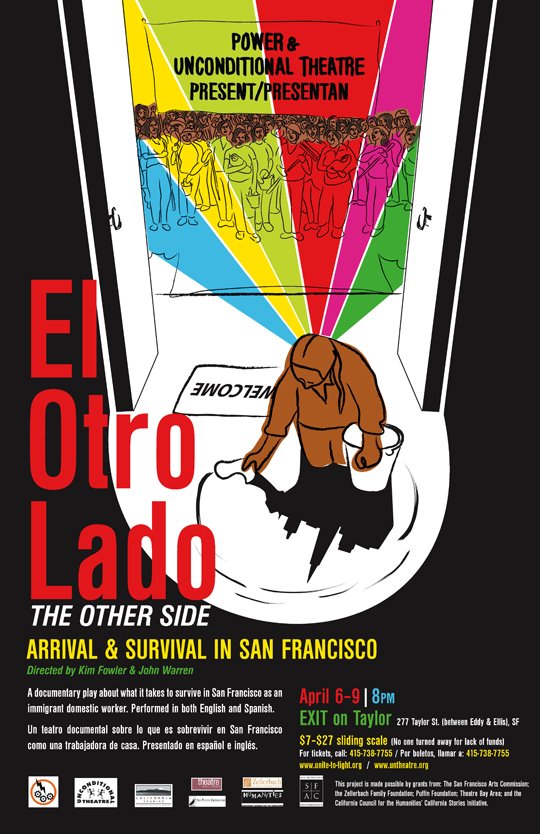 POWER (People Organized to Win Employment Rights) &
Unconditional Theatre Present:
EL OTRO LADO /
THE OTHER SIDE
ARRIVAL & SURVIVAL
IN SAN FRANCISCO
Performed in English & Spanish
April 6-9 @ 8PM
EXIT Theater on Taylor
277 Taylor St. (between Eddy & Ellis)
$7-$27 sliding scale
For tickets, call 415-738-7755
El Otro Lado shines a light on the untold and unseen lives, histories and struggles of low-wage Latina domestic workers in San Francisco. The vast majority of these workers are immigrants from the Global South who uproot their lives and cross borders to secure the promise of the American Dream. Performed by POWER members and low-wage workers and scripted from interviews with domestic workers and their families, as well as organizers, lawyers and politicians. Directed by Kim Fowler & John Warren.
Sunday, March 26, 2006
Theater Criticism and the US Flag Code
 "Any art so vulnerable that it needs euphemized reviews to survive ought to be put out of its misery, just as any country that needs to outlaw flag burning ought to think again about what loyalty means." Jonathan Kalb, The Death (and Life) of American Theater Criticism
Brush up on your US Flag Code
Weigh in on the following question: What are the functions of a theater critic?
Bang or Whimper?
 Delightful End of the World Senario.
Lisa Says...
"When someone asks if you'd like cake or pie, why not say you want cake and pie?" Lisa Loeb
Tuesday, March 14, 2006
Happy Pi Day
It's today and the number is Pi.
Bonus: It's Enstein's birthday. "The faster you go, the shorter you are."
3.1415926535897932384626433832795028841971693993751058
209749445923078164062862089986280348253421170679821480
865132823066470938446095505822317253594081284811174502
841027019385211055596446229489549303819644288109756659
334461284756482337867831652712019091456485669234603486
104543266482133936072602491412737245870066063155881748
815209209628292540917153643678925903600113305305488204
665213841469519415116094330572703657595919530921861173
819326117931051185480744623799627495673518857527248912
279381830119491298336733624406566430860213949463952247
371907021798609437027705392171762931767523846748184676
694051320005681271452635608277857713427577896091736371
787214684409012249534301465495853710507922796892589235
420199561121290219608640344181598136297747713099605187
072113499999983729780499510597317328160963185950244594
553469083026425223082533446850352619311881710100031378
387528865875332083814206171776691473035982534904287554
687311595628638823537875937519577818577805321712268066
130019278766111959092164201989380952572010654858632788
659361533818279682303019520353018529689957736225994138
912497217752834791315155748572424541506959508295331168
617278558890750983817546374649393192550604009277016711
etc. etc.
Bonus: It's Enstein's birthday. "The faster you go, the shorter you are."
Sunday, March 12, 2006
Improvisation
 "It's not easy to improvise, it's the most difficult thing to do. Even when one improvises in front of a camera or microphone, one ventriloquizes or leaves another to speak in one's place the schemas and languages that are already there. There are already a great number of prescriptions that are prescribed in our memory and in our culture. All the names are already preprogrammed. It's already the names that inhibit our ability to ever really improvise. One can't say what ever one wants, one is obliged more or less to reproduce the stereotypical discourse. And so I believe in improvisation and I fight for improvisation. But always with the belief that it's impossible. And there where there is improvisation I am not able to see myself. I am blind to myself. And it's what I will see, no, I won't see it. It's for others to see. The one who is improvised here, no I won't ever see him." Jacques Derrida (unpublished interview, 1982)
This quote is striking to me as someone who builds work through Viewpoints. It acurately describes the necessity for effacement. Effacement of the self to the point that one can simply respond to an impulse coming from another live body in the present.
Saturday, March 11, 2006
Thanks For All The Fish

 Crunch-a-tize me Cap'n! 'Coz Chik'in A Biscuit has a bold new look. Same great taste. Bold new look. Good thing we're capable of revolutionizing the snack cracker because the fish are a done deal. There is no fish that doesn't contain mercury. Recent news reports advise pregnant women not to eat more than one can of tuna a week if they are eating fresh fish of any sort. Better to eat no fish at all. Shame on us.
Got Mercury?
mercury hair sampling kit
estimate of your current levels of mercury exposure
Random Elements Found On Desk
Site logging historical landmarks and markers
Free books
Conscious media consumption
Subscribe to:
Posts (Atom)